
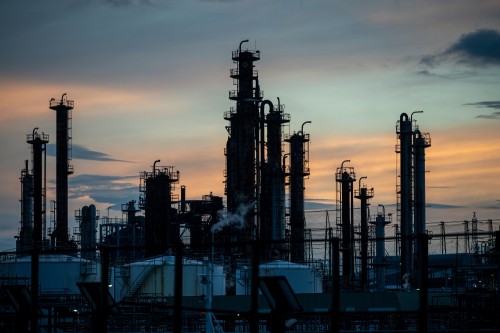
Tensions in the Middle East sparked a surge in oil prices and unsettled global bond markets on Monday, raising concerns about inflation and potential interest rate hikes by central banks. Brent crude, the global oil benchmark, saw an increase following an attack on a nuclear power plant in the United Arab Emirates. Simultaneously, stalled peace negotiations between the U.S. and Iran added to the market’s unease. Former President Donald Trump heightened tensions with a social media post urging Iran to act swiftly to avoid severe consequences.
Brent crude prices climbed as much as 1.77% to reach $111.16 per barrel, marking the highest level in nearly two weeks, though they later settled at $110 after Iran responded to a new U.S. proposal aimed at resolving the conflict. Iran’s foreign ministry confirmed ongoing dialogues facilitated by a Pakistani mediator, although specific details were not disclosed.
In the bond markets, volatility was evident as the U.S. 10-year Treasury yield hit 4.631%, its peak since February 2025, before easing to 4.599%. The UK’s 10-year gilt yield also experienced fluctuations, reaching a high of 5.19% before settling back to 5.15%. Political uncertainty contributed to the instability in the UK, as speculation arose over a potential leadership challenge to Prime Minister Keir Starmer by Manchester Mayor Andy Burnham. UK Chancellor Rachel Reeves joined other G7 finance ministers in Paris to discuss the economic ramifications of the Middle Eastern conflict.
Market analyst Mohit Kumar indicated that bond investors were apprehensive about a possible leftward shift in UK politics, with concerns that increased public spending could strain the country’s fiscal capabilities. Meanwhile, Kathleen Brooks from XTB suggested that UK bond yields might recover if market sentiments perceive a restraint on Burnham’s spending tendencies. The critical test for UK markets would be whether the 10-year yield could dip below 5%.
Across the globe, Japan’s bond yields rose, with the 10-year yield reaching nearly a 30-year high at 2.8% as the government prepared to issue more debt to mitigate the economic impact of the Middle Eastern conflict. European stock markets opened lower, with the Stoxx Europe 600 falling by 0.7%, while the UK’s FTSE 100 remained mostly unchanged. In Asia, Japan’s Nikkei and Hong Kong’s Hang Seng index both dropped by about 1%, while China’s SSE Composite saw a slight decline of 0.1%. Conversely, South Korea’s Kospi index closed 0.3% higher.